
Authorisation Letter Template
An authorisation letter lets someone you trust do something on your behalf — collect a parcel or document, pick up a child from school, speak to your bank or utility, or drive your car. This pack gives you editable letters for the most common situations, with guidance on the details organisations usually ask for.
- Instant download
- Editable Word
- Print-ready PDF
- 7-day refund
8 files · DOCX, PDF
Authorisation Letter Templates
Seven editable authorisation letters — general, document collection, parcel collection, child pick-up, bank or utility, vehicle use and revocation — with a guidance sheet.
- General authorisation letter (DOCX)
- Document collection letter (DOCX)
- Parcel collection letter (DOCX)
- + 5 more
$5.00 USD, one-time 8 files · about $0.63 each
- Instant download
- 7-day refund
- Secure checkout by Stripe
7-day money-back guarantee. Full refund within 7 days of purchase, even after you download.
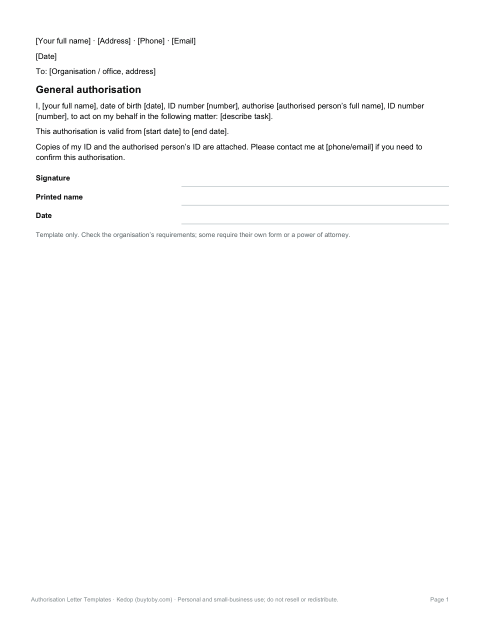
Free sample: General Authorisation Letter (PDF, 51 KB)
Authorisation Letter Templates
Seven editable authorisation letters — general, document collection, parcel collection, child pick-up, bank or utility, vehicle use and revocation — with a guidance sheet.
- General authorisation letter (DOCX)
- Document collection letter (DOCX)
- Parcel collection letter (DOCX)
- Vehicle use letter (DOCX)
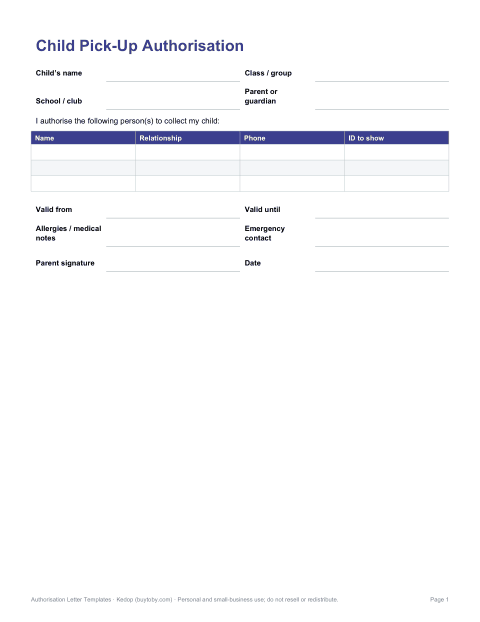
- Child pick-up authorisation (DOCX)
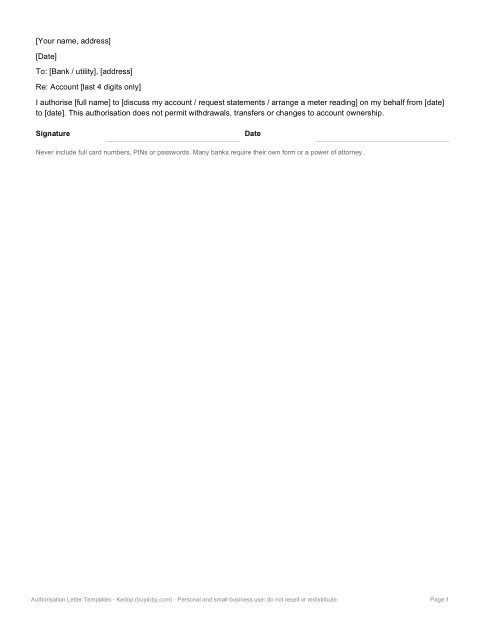
- Bank / utility account letter (DOCX)
- Revocation letter (DOCX)
- Guidance sheet (PDF, DOCX)
Formats: DOCX, PDF. Instant download after payment (link valid 72 hours, up to 5 downloads). AI-assisted: the templates were drafted with AI help and reviewed and laid out before publishing.
$5.00 USD, one-time 8 files · about $0.63 each
- Instant download
- 7-day refund
- Secure checkout by Stripe
7-day money-back guarantee. Full refund within 7 days of purchase, even after you download.
Free sample: General Authorisation Letter (PDF, 51 KB)
Full refund within 7 days — see the refund policy and license.
Free printables
Single sheets you can print right now, no sign-up. The full pack adds every sheet in one download plus the editable files.
 General Authorisation Letter Template1 page · free PDF
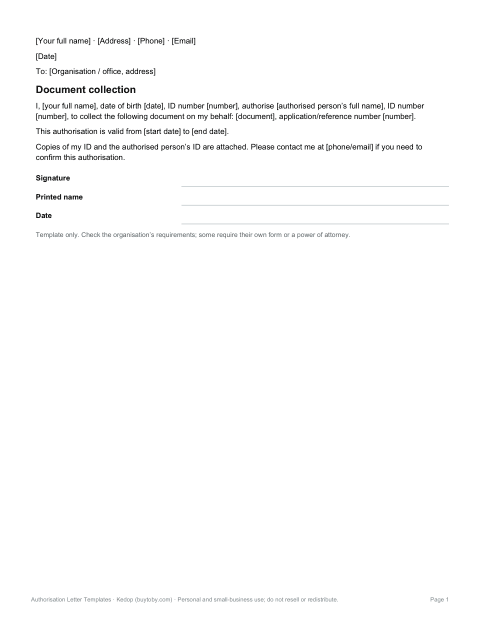
 Document Collection Letter Template1 page · free PDF
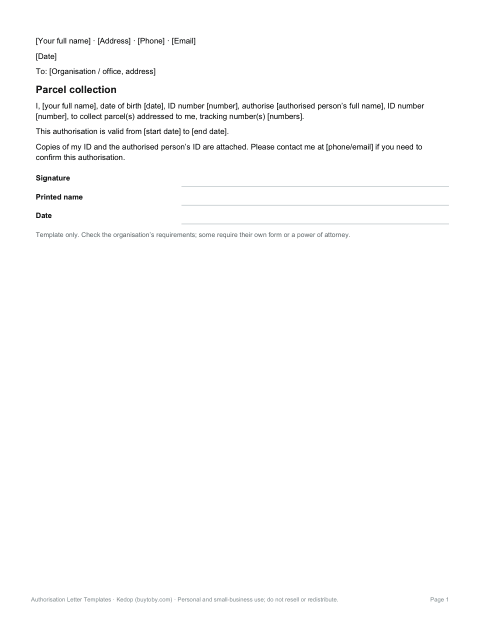
 Parcel Collection Letter Template1 page · free PDF
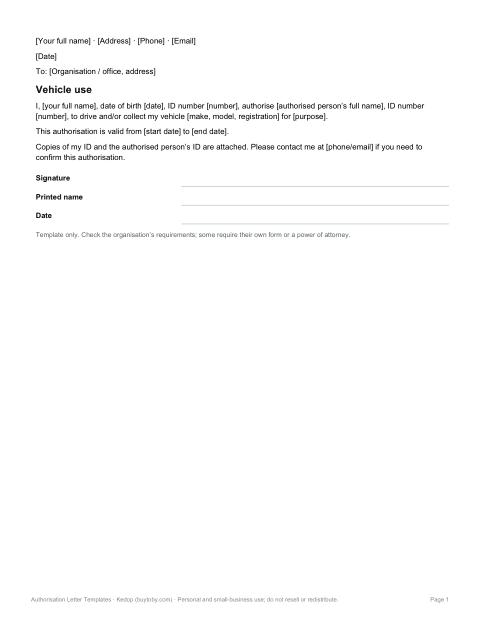
 Vehicle Use Authorisation Letter Template1 page · free PDF
 Child Pick-Up Authorisation Letter1 page · free PDF
 Bank Authorization Letter Template1 page · free PDF
 Revocation of Authorisation Letter1 page · free PDF
 Authorisation Letter Guidance Sheet1 page · free PDF
What an authorisation letter must include
| Element | Why it matters |
|---|---|
| Your full name, address and contact details | Identifies who is giving permission |
| The authorised person’s full name | Identifies who may act; match it to their ID |
| Exactly what they may do | Collect, sign, discuss, pay — be specific |
| Where and with whom | The organisation, branch or office |
| Dates of validity | A start and end date or a single date |
| Reference numbers | Account, order, case or passport application numbers |
| Reason (optional) | Travel, illness, work commitments |
| Your signature and date | Confirms the permission |
| ID copies | Many organisations ask for copies of both people’s ID |
Common uses
- Collecting documents — passports, certificates, transcripts, licences or visas where the issuing office allows collection by a representative.
- Collecting parcels — from a post office or courier depot.
- School pick-up — allowing a named adult to collect a child.
- Banks and utilities — letting someone discuss or manage an account (many banks have their own forms or require a power of attorney for ongoing access).
- Vehicles — allowing someone to drive or collect your car, for example from a repair shop.
- Landlords and property — letting a relative or agent inspect, collect keys or deal with repairs.
Authorisation letter vs power of attorney
An authorisation letter is a simple, specific permission for a particular task or period. A power of attorney is a formal legal document that gives someone broad or ongoing authority over financial or health decisions, and usually has strict signing and witnessing requirements. Banks, government agencies and courts often require a power of attorney or their own forms for anything significant. If an organisation will not accept a letter, ask what they require.
Tips for getting it accepted
- Call or check the organisation’s website first — many publish exactly what they need.
- Be specific about the task, dates and references; vague letters are often refused.
- Attach copies of both people’s photo ID and ask the authorised person to bring their original ID.
- Sign in ink, and have the letter witnessed or notarised if the organisation asks.
- Keep a copy for yourself.
- For recurring tasks, state an end date so the permission does not last forever.
What is in the template pack
- General authorisation letter — adaptable to any task.
- Document collection letter — for certificates, passports and official documents.
- Parcel collection letter.
- Child pick-up authorisation — with emergency contact and allergy notes.
- Bank / utility account letter — for limited discussions and tasks, with a note on when a power of attorney is needed.
- Vehicle use letter — driver details, vehicle registration and dates.
- Revocation letter — to withdraw a permission.
Worked example
Maria is travelling when her new passport will be ready and asks her brother Tomás to collect it. Using the document collection template, she writes her full name, address and application reference, Tomás’s full name and ID number, the office address, and that he may collect only her passport between 10 and 24 June. She attaches a copy of her ID and his, signs and dates the letter, and checks the passport office’s website, which confirms that representatives may collect with a signed letter and original ID.
Who it is for
Anyone who needs someone else to handle a task for them: travellers, busy parents, older people with family helpers, students abroad and small-business owners delegating errands.
Formats
Editable Word (DOCX) letters with PDF copies. Replace the bracketed placeholders, delete lines you do not need and print on plain paper or letterhead.
A note on safety
Only authorise people you trust, give the minimum permission needed, and set an end date. Never include full bank card numbers, PINs or passwords in an authorisation letter. If a letter is lost or you change your mind, tell the organisation and use the revocation template.
Frequently asked questions
How do I write an authorisation letter?
State who you are, who you authorise, exactly what they may do, where, for what dates and references, then sign and attach ID copies.
Does an authorisation letter need to be notarised?
Usually not, but some organisations ask for it; check their requirements.
Is an authorisation letter the same as a power of attorney?
No. A power of attorney is a formal legal document for broad or ongoing authority.
Can I use the templates for school pick-up?
Yes, there is a child pick-up authorisation template.
Was AI used to create the templates?
The templates were drafted with AI assistance and then reviewed, edited and formatted before publishing. They are not legal advice.